Round Numbers
Originally posted on LinkedIn on 17 May 2025.
Last weekend I ran a half marathon after three months of specific training. I had a target time in mind, with a stretch goal if everything lined up. It was hot and my breakfast disagreed with me, so I crossed the line four minutes over. Disappointing!
A few days later I headed out for a short recovery run. No watch beeping about suboptimal pace or heart rate, no plan beyond "move for half an hour or so". The freedom felt incredible. Those back-to-back outings made me think of how performance lives in two modes: the structured drive toward a number and the simple joy of the activity.
Among nine million marathon results, a finish at 3:59:59 is about 40% more common than one at 4:00:01. The same little spike repeats before every neat half-hour. Nothing physiological changes at 4h00m. The shift is entirely in our heads.
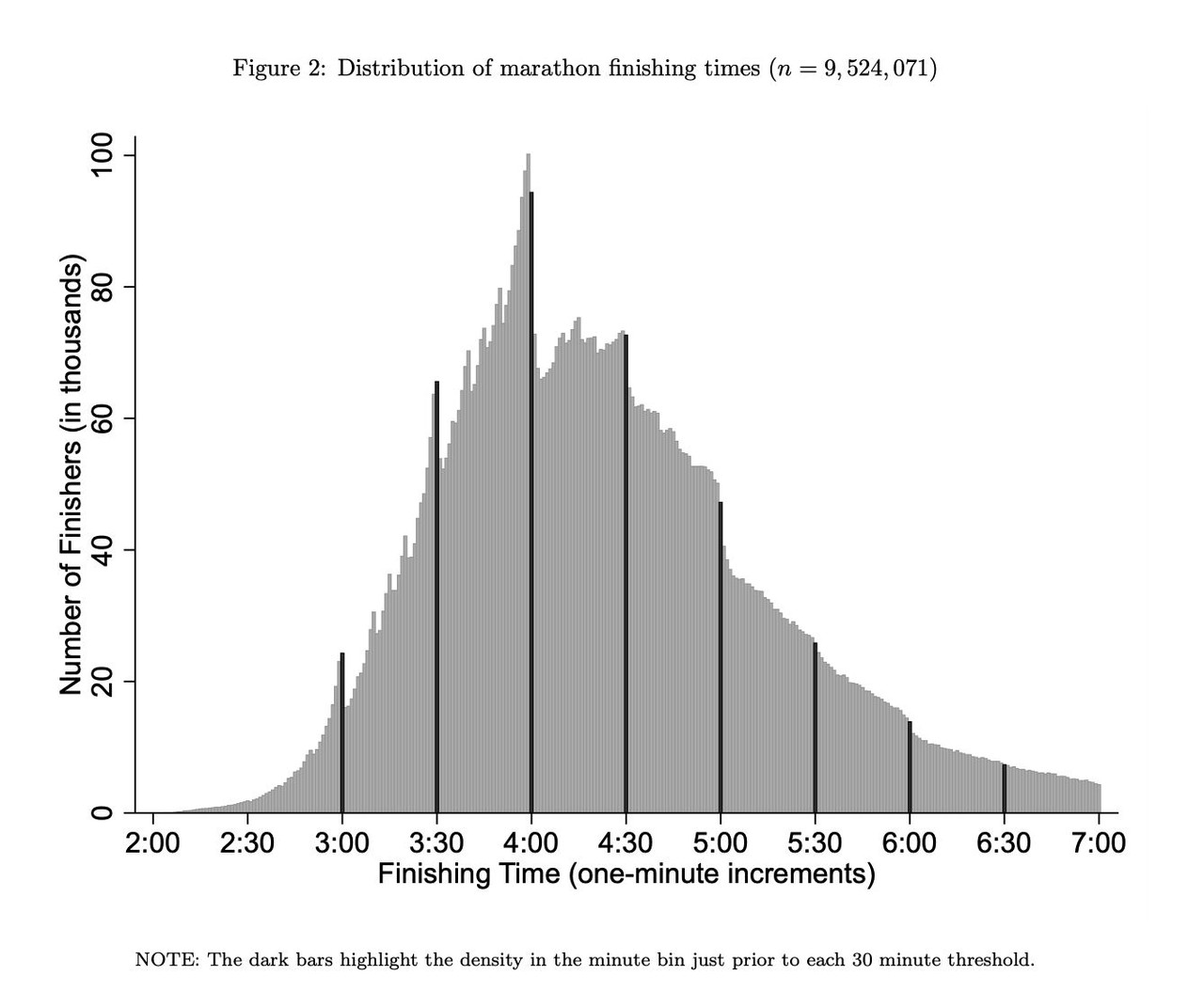
We inherit our targets from the way we count: ten fingers for decimals, Babylon's sixty for time, dozens for eggs and clocks. Those ancient rhythms still steer what we call success.
I once spent months nudging a 95th-percentile latency under 200ms, watched teams celebrate crossing $2B AUM, and products priced at $9.99 instead of an arguably equally sensible $10.63. Each number focused effort and turned intention into action. None of them was sacred.
Targets give us urgency and a shared vocabulary. Unstructured moments give us perspective and resilience. Hold both. Numbers steady us and make the abstract concrete, but the value we create lives between the ticks of the stopwatch, well beyond any round number we choose to chase.
Source: Eric J. Allen et al., "Reference-Dependent Preferences: Evidence from Marathon Runners", NBER Working Paper 20343